


Eating Mindfully-Make your own Starter

We hear a lot about mindfulness these days. We understand what that means in our yoga practice, but what about in our kitchens? What we used to consume and prepare was lovingly arranged and served. Now we are so busy with life and work, we prioritize convenience.
As we've seen the decay of convenience foods. We used to justify them through cost, but the quality has decreased while the cost has increased. Now we find ourselves at an interesting crossroad. Do we slow down and learn to prepare these foods ourselves, or sadly succumb to a system that was never designed to nourish us?
I have chosen the former. 95% of the foods we consume in our home are scratch made. Contrary to tired naysayers, I believe it is achievable by every household to explore scratch-made cooking. The perceived value is not shared by many, because we have so much important stuff to do. Consuming good, delicious, low-processed foods is a goal we should all embrace. The biggest deterrent is time, but its mostly a waiting game with good cooking. So we'll start with bread, the MOST WASTED COMMERCIALLY AVAILABLE FOOD.
Yeast is easily purchased from any grocery store, but if you'd like have your own starter you can make your own, or purchase one from a home baker. I have one available to purchase.
How to make a sourdough starter.
*This method is designed to reduce waste so that there isn't any discarded starter.
What do you need:
A jar-it doesn't need to be huge, just large enough to accommodate the doubling of the starter.
A stirrer-sometimes I use a chopstick, sometimes a spatula. as long as it reaches the bottom of the jar.
A marker-it can be a rubberband or a sharpie, anything to help you identify where the starter began and where it has risen.
FLOUR-this is the most contentious material. I started with a sack of enriched flour because it was inexpensive and did the job. I now use high quality unbleached wheat flour. Yes, you can change the flour later. I will cover in a later post the benefit of good flour.
Water-also a point of contention. Depending where you live, you may be discouraged from using tap water. ANY water is fine. I use tap water, but you can use purified water if it serves you.
How to create your starter:
Add 1 tbsp of flour and 1 tbsp water to jar and stir stir stir, loosely fit your lid onto the jar as some gas needs to escape and starter likes oxygen.
place in a cabinet or leave on the counter if the ambient temp isnt too cold or warm and wait 24 hours
Add 1 tbsp flour and 1 tbsp water
wait 12 hours. choose a time that is easy to remember, I like 7 am because I am up well before 7 and preparing for bed around 8.
From the last step every 12 hours add 1 tbsp flour and 1 tbsp of water.
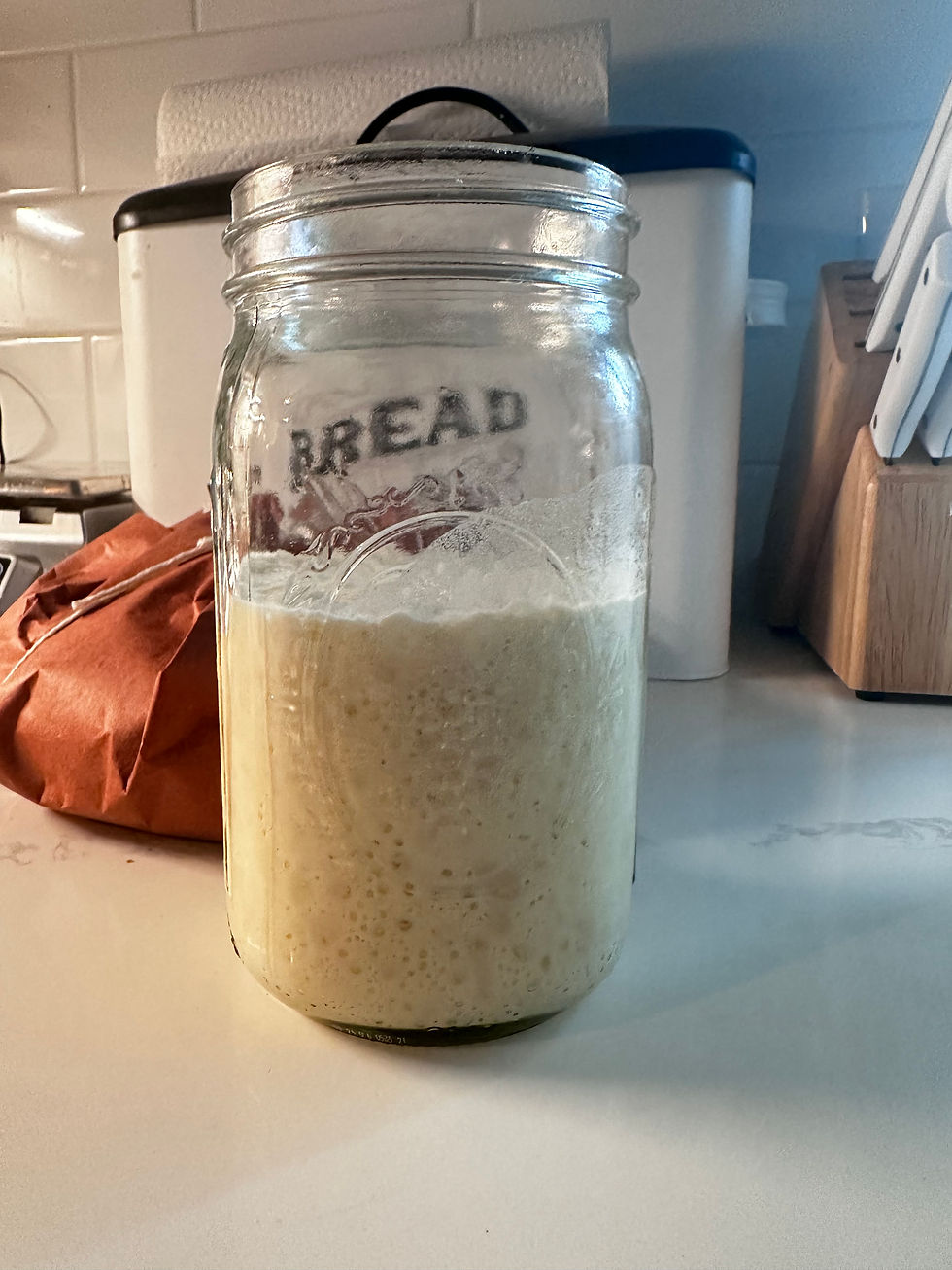
you should begin seeing some bubbles on day 3 or 4.
Continue this process until you see the starter double within 8 hours.
Sometimes this takes only a week, for me it took 13 days. Just be patient.
**Once you see it doubling it 8 hours, you have yourself your very own sourdough starter, you can give it a name and use it for years to come!
Issues that may arise.
You miss a feeding- don't worry, just feed it as soon as you remember and continue your schedule as if nothing happened.
The mixture is stinky- if it has a dark liquid on top, toss out and start over. If its just been a while since its last feeding, feed it, it may just be hungry.
Mold- THROW AWAY IMMEDIATELY. Mold is a nonnegotiable. There is no way to reclaim a moldy starter.
No growth even after several days- try switching flours. a bag of rye, whole wheat will jump start production.
As always, if you have any questions or concerns or think I missed something, just shoot us a message!


Comments